


An authentic Tibetan singing bowl is hand-hammered by a real artisan, made from a traditional metal alloy, and carries a slightly uneven shape and tone that no machine can copy. If your bowl looks perfectly symmetrical, sounds identical to a hundred others online, and costs less than a nice dinner, it’s probably not the real thing.
That matters more than most buyers realize. Singing bowls have become hugely popular for meditation, yoga, and sound healing, and with that popularity has come a flood of mass-produced, machine-pressed imitations sold as “Tibetan” or “Himalayan.” Learning to tell the difference protects your wallet—and honors the artisans who’ve kept this centuries-old craft alive.
In this guide, we’ll walk through exactly how to identify an authentic Tibetan singing bowl, why authenticity affects the sound and spiritual value of the bowl, and where to buy one that’s genuinely hand-hammered in Nepal.
Table of Contents
Why Authenticity Matters When Buying a Tibetan Singing Bowl
Before we get into the checklist, it helps to understand why this distinction is such a big deal.
Traditional singing bowls are forged from a bell-metal alloy (typically copper and tin, sometimes with trace amounts of other metals) and shaped entirely by hand over an open flame. This hand-hammering process is what gives a real bowl its complex, multi-layered tone—the sound literally comes from the irregularities in the metal that machine pressing eliminates.
According to the Smithsonian Folkways archive on Himalayan sound traditions, singing bowls have deep roots in Himalayan Buddhist and Bon ritual practice, valued for centuries not just as objects but as tools tied to specific artisan lineages. A machine-stamped bowl from a factory has none of that lineage—and, acoustically, it often produces a single flat tone instead of the rich harmonic “singing” people are looking for.
If you’re buying a singing bowl for meditation, sound therapy, or as a meaningful gift, authenticity isn’t just about ethics—it directly affects the experience you’re paying for.
7 Ways to Spot an Authentic Tibetan Singing Bowl
1. Check for Hammer Marks
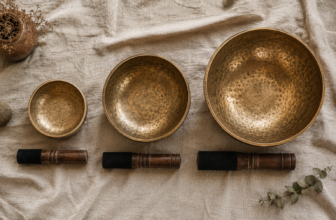
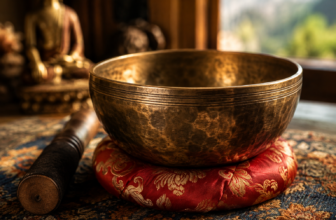
Every genuinely hand-hammered singing bowl will show small, irregular hammer marks on the inside and outside surface—faint dimples, slight asymmetry, and subtle texture changes. A machine-made bowl will look flawless, uniformly smooth, and almost too perfect. If you can’t find a single imperfection, be suspicious.
2. Listen for a Layered, Evolving Tone
Strike or rim a real bowl and listen closely. An authentic bowl produces a tone that shifts and layers as it resonates—sometimes described as having “overtones.” Cheap machine-pressed bowls tend to produce one flat, static note that doesn’t evolve.
3. Weigh It in Your Hand
Handmade bowls often have slightly uneven wall thickness because they’re shaped by hand, not cast in a mold. This gives them a distinct, sometimes slightly off-balance weight distribution. Mass-produced bowls are usually perfectly even because they’re stamped from sheet metal.
4. Ask Where and By Whom It Was Made
A legitimate seller should be able to tell you specifically where the bowl was made—for example, artisan communities in the Kathmandu Valley or Patan, Nepal—not just “sourced from the Himalayas.” Vague sourcing claims are one of the biggest red flags in this industry.
5. Inspect the Base
Authentic bowls typically have a slightly rough or matte base where the metal was hand-finished, sometimes with a visible center point from the original hammering process. Mass-produced bowls often have a perfectly flat, machine-polished base.
6. Compare the Price
This one’s simple: a genuinely hand-hammered singing bowl takes hours (sometimes days) of skilled labor to make. If you see a “handmade Tibetan singing bowl” priced under $20–30, it almost certainly isn’t. Real craftsmanship has a real cost—and fair wages for artisans are part of that.
7. Look for Certification or Artisan Story
Reputable sellers of authentic Tibetan singing bowls will show you the artisan workshop and the process or at least explain their sourcing in detail. If a brand can’t answer “who made this and where,” that’s your answer.
Real Example: What to Look For Before You Buy
If you’re shopping online, here’s a quick gut-check before adding a bowl to your cart:
- Does the listing mention a specific location in Nepal (not just “Himalayan region”)?
- Are there photos of the actual bowl, not just stock images?
- Does the description mention “hand-hammered” specifically, not just “handmade” (a looser term)?
- Is there a sound sample or video?
- Does the price reflect real craftsmanship (generally $40+ for a genuine small bowl)?
If you answered “no” to more than one of these, keep looking.
How Himalayan Craft House Ensures Authenticity
At Himalayan Craft House, every singing bowl is hand-hammered by skilled artisans in Nepal’s Kathmandu Valley and Patan—the same regions singing bowl craftsmanship has come from for generations. We work directly with these artisans, paying fair wages, with no factory shortcuts or mass production involved.
If you’re ready to see the difference for yourself, browse our collection of authentic hand-hammered singing bowls, including our Seven Chakra Singing Bowl Set and Old Tibetan Singing Bowl—each one photographed and listed individually, not mass-batched.
Not sure which size or tone fits your practice? Our Ultimate Singing Bowl Buyer’s Guide breaks down sizing, tone, and use case in detail. And if you want to understand the deeper benefits before you buy, check out our Tibetan Singing Bowl Guide: 7 Powerful Benefits.
Frequently Asked Questions
How can I tell if my Tibetan singing bowl is real?
Check for irregular hammer marks, a layered evolving tone, uneven weight distribution, and a rough hand-finished base. A seller who can clearly explain where and how the bowl was made is also a strong signal of authenticity.
Are all singing bowls from Nepal authentic?
Not automatically. “Made in Nepal” can still mean factory-produced. True authenticity comes from hand-hammering by individual artisans, which you can usually verify through hammer marks, tone quality, and the seller’s transparency about sourcing.
Why are authentic Tibetan singing bowls more expensive?
Because they require hours of skilled manual labor per bowl, made by artisans who are paid fairly for traditional craftsmanship—unlike mass-produced, machine-stamped alternatives.
Where can I buy a genuine hand-hammered singing bowl?
Look for sellers who work directly with named artisan communities, like the Kathmandu Valley or Patan in Nepal, and who photograph and describe each bowl individually rather than selling generic stock images. Himalayan Craft House is one such source, with every bowl hand-hammered and ethically sourced in Nepal.
An authentic Tibetan singing bowl isn’t just a purchase—it’s a piece of a living craft tradition, made by real hands in Nepal. By checking for hammer marks, tone quality, base finish, and artisan transparency, you can confidently tell a genuine bowl from a mass-produced imitation.
If you’re ready to experience the difference a truly hand-hammered bowl makes, explore our full collection—every piece handmade with care, tradition, and fair wages for the artisans who craft them.




[…] a flat, identical note across mass-produced bowls. If you haven’t already, read our guide on how to spot an authentic Tibetan singing bowl before buying a chakra set, since the same authenticity checks […]